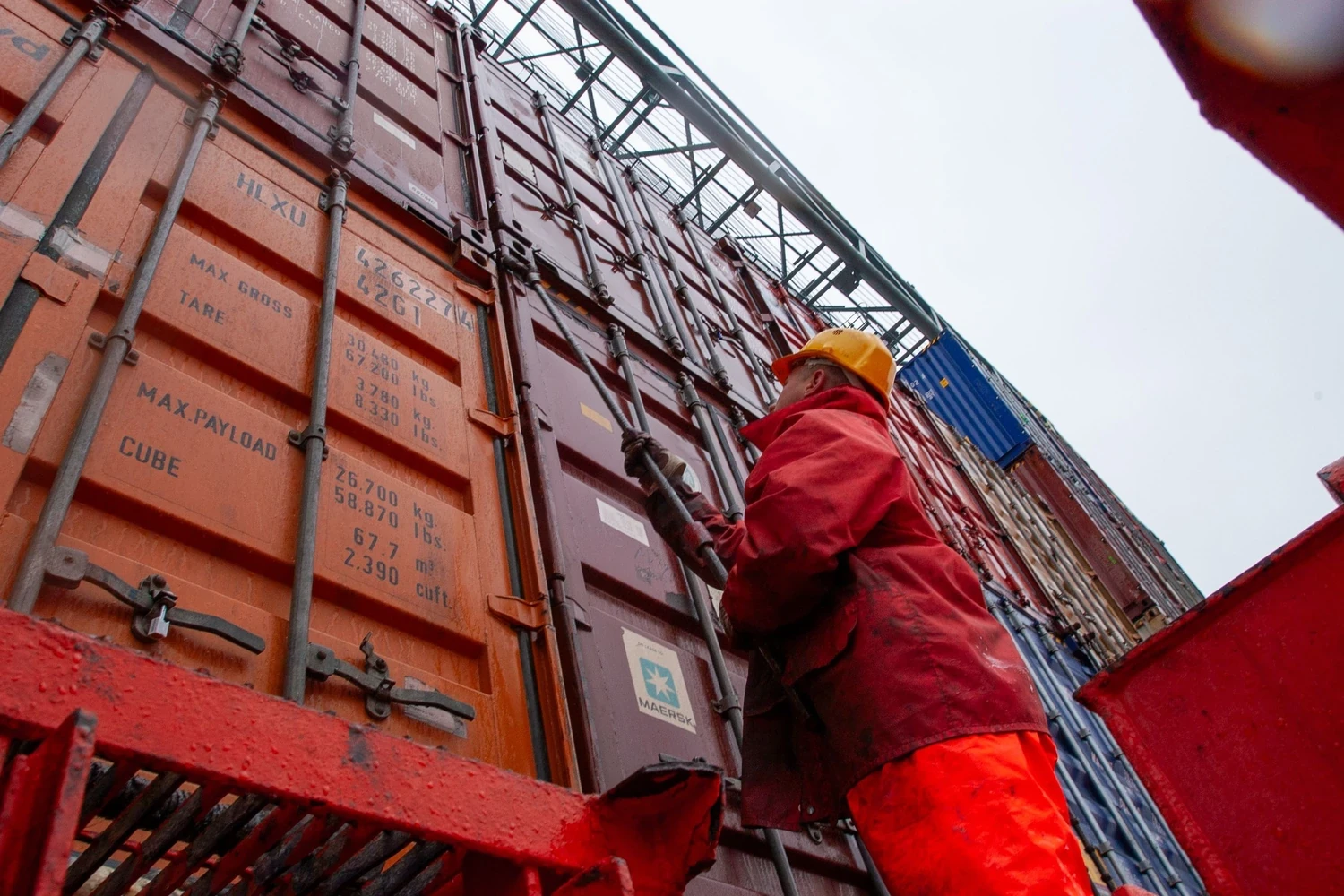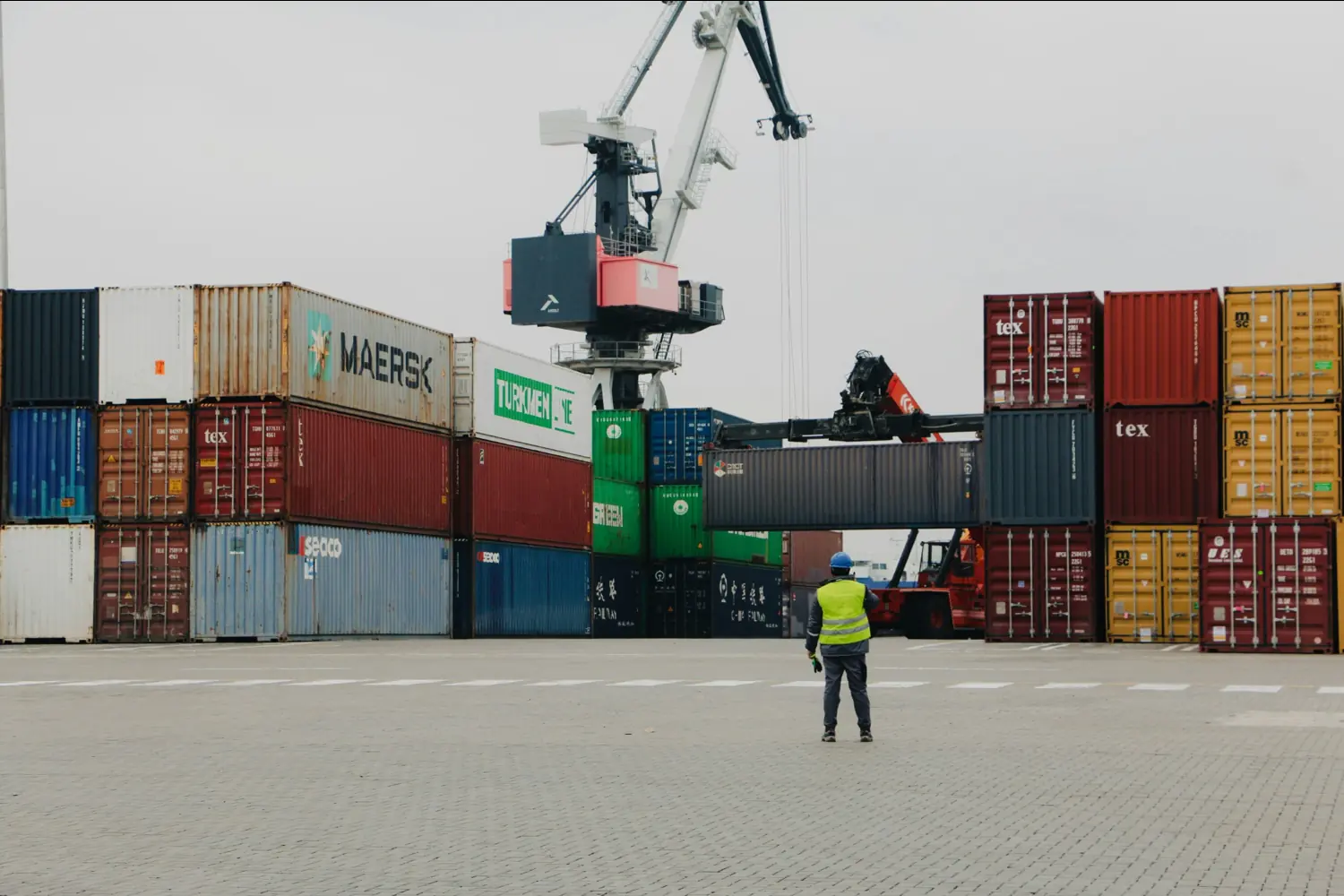
Every shipment that crosses an external EU border must pass a checkpoint before it can proceed: customs. A container can be fully paid for, correctly packed, and completely legal, and yet stand for days in the Hamburg terminal because a single line on the commercial invoice does not match the electronic declaration submitted before the ship sailed. This discrepancy shows customs clearance in miniature: a paperwork process that decides whether goods are released for delivery or held behind a gate.
For any business importing or exporting products to or from the EU, customs clearance is not a side issue. It is the checkpoint on which the entire supply chain depends.
What customs clearance actually means
Customs clearance is the process by which a country's customs authority formally releases goods for import or export into or out of its territory. In Germany, this authority is the Customs (Zoll). Once release is granted, the goods proceed to delivery; until then, they are stored in a bonded warehouse or at the port, incurring storage costs.
Three checks run simultaneously: an automated assessment of whether the documentation is complete and consistent, a calculation of the duties and import VAT owed, and a compliance check confirming that the goods are legally permitted for import. Clearance is not an automatic formality that occurs as soon as a carrier books a shipment: a declaration must be actively submitted by the importer, a customs broker, or a carrier, and it must be correct.
Why this is important for your business
The consequences of an error are tangible. A shipment held in Hamburg for a week can consume inventory buffers, cause a delivery window at a retailer to be missed, and incur demurrage and storage fees that erode the margin on the order. For businesses delivering to Amazon FBA, a hold-up can cause a shipment to miss its assigned delivery window, requiring a new booking and another waiting period.
There is also a compliance dimension: incorrectly declared values, wrong HS codes, or missing certificates trigger audits and increased scrutiny on future shipments. German customs applies a risk assessment model, meaning a clean compliance history over time translates to faster clearance, one of the reasons why established importers eventually apply for AEO status, which is discussed further below.
How the process works in Germany
Germany processes almost all declarations electronically via ATLAS, its digital platform for declaration and risk assessment, which has been practically mandatory since the introduction of "ATLAS 10.2" at the end of 2025. This version also brought centralized clearance: a declaration is submitted to a German customs office even if the goods physically enter via another EU port.
The process goes through several stages that begin well before reaching ATLAS:
Every importer requires a valid EORI number before a declaration can be submitted. Processing times are inconsistent; even with complete documentation, it can take several weeks during peak times. Apply four to six weeks before the expected arrival.
Every product requires a code under the EU's Combined Nomenclature, which is extended to 10 to 11 digits under TARIC for imports, incorporating anti-dumping duties and quotas. This determines the duty rate, whether licenses are required, and if the goods are subject to trade restrictions.
Before the goods arrive, an Entry Summary Declaration (ENS) must be submitted, a risk assessment of the goods that is now mandatory for sea, air, road, and rail transport. A late or inconsistent ENS can flag a shipment before it even reaches German territory.
Upon arrival, the importer or their representative submits the import declaration in ATLAS, which includes tariff classification, declared value, and origin. ATLAS routes the shipment into one of three channels: green (release), yellow (document check), or red (physical inspection). Express air freight shipments with clean paperwork are often cleared within hours; standard ocean freight typically takes one to three business days, and an inspection in the red channel extends this by another three to seven days.
Once the declaration is accepted, duty and import VAT become due. Regular importers can apply for a deferment account and settle monthly instead of per shipment.
For export, a corresponding process takes place: a declaration is submitted before export, an MRN (Movement Reference Number: the unique reference generated upon acceptance of the declaration to track and confirm movement) is assigned after acceptance, and once the goods have physically left the EU customs territory, an export confirmation is recorded. This export confirmation is also what qualifies the associated sale for zero-rated VAT. Without it, the exporter cannot prove the zero-rating during a subsequent tax audit.
The most important documents
Required for almost every shipment:
A valid EORI number for the importer: Without it, ATLAS will not accept a declaration.
A commercial invoice showing the actual transaction value, agreed Incoterms, country of origin, and a specific product description. "Electronic components" draws closer scrutiny in a way that "USB-C charging cable, 60 W, model X200" does not. Generic descriptions are one of the most common triggers for closer inspection.
A packing list that matches the invoice and cargo in terms of box count, weight, and dimensions.
Transport documents (Bill of Lading or Air Waybill) as proof of movement and ownership.
A signed power of attorney authorizing the customs broker to declare on behalf of the importer.
Required in specific cases:
A certificate of origin for a preferential duty rate
A CE declaration of conformity for electronics and machinery
Phytosanitary certificates for plants and food items
Safety data sheets for chemicals
Import licenses for goods under control regimes, such as pharmaceuticals
The most common cause of issues is not a missing document, but inconsistencies between them: a value that does not match across different declarations, or a description vague enough to fit more than one HS code.
Customs broker or self-filing?
There is no legal requirement to use a customs broker for most goods, but few businesses file themselves in the long run: a broker declaring on behalf of a client typically assumes joint and several liability for errors, which is why many German customs brokers refuse to declare for a non-EU business unless it has an EU-established entity acting as the importer.
Self-filing is suitable for businesses that ship infrequently, deal with low-risk goods, and have internal HS classification and ATLAS expertise. For most others, a customs broker or freight forwarder is worth it: they recognize what is likely to trigger an inspection before the declaration is submitted, bear the liability if something goes wrong, and can resolve queries directly with customs. Customs brokers also typically have or have easier access to deferment accounts and AEO agreements, which are often difficult for an occasional importer to obtain independently.
Calculation of duty and import VAT
Germany calculates duty using the CIF method: duty is assessed on the value of the goods plus freight and insurance costs up to the EU border. Thus, an order worth €1,000 with €150 in freight and insurance costs has a customs value of €1,150, and duty is levied on this total amount.
The rate to be applied depends on the HS/CN code, which is why correct classification has concrete financial consequences: an incorrect code can mean years of over- or underpayment, followed by corrections and fines. Duty is only incurred on a declared value of over €150, whereas import VAT applies starting from over €22.
To illustrate: a customs value of €1,150 at a duty rate of 4% results in €46 duty. VAT is then calculated at 19% on the customs value plus this duty (€1,196), which results in €227.24, making a total of €273.24 in customs charges in addition to the goods and freight.
Import VAT in Germany is regularly 19%, and reduced to 7% for a limited category such as books. VAT-registered businesses can usually reclaim this through their VAT return, but they must first pay it at the border, a liquidity gap that a deferment account can mitigate.
Common reasons for customs delays
Most delays can be traced back to a limited number of causes: a discrepancy between the importer named on the invoice and the EORI number used in the declaration; a late or incomplete ENS filing; vague product descriptions such as "parts" or "accessories," which are flagged as risk indicators; missing certificates for regulated goods; discrepancies in declared value between the invoice, ENS, and ATLAS declaration; and non-compliant packaging, such as untreated wood pallets that do not meet the ISPM-15 standard. Delays are rarely due to an issue with the goods themselves; they arise because the documentation describing those goods is inconsistent somewhere along the chain.
How much does customs clearance cost?
Three cost categories are often grouped under "customs clearance." The first is duty and import VAT, set by law. The second is the customs broker's clearance fee, which varies with the complexity and volume of the shipment; regular, high-volume shippers typically secure better terms. The third only arises when something goes wrong: storage fees, demurrage if a container exceeds its free time, and inspection fees for a shipment in the red channel.
This third category is usually the largest and the one most within the business's control. A well-documented, correctly classified shipment incurs the basic clearance fee and nothing more; one with a documentation issue can cost many times that before it reaches the warehouse.
How we handle customs clearance for you
We declare directly via ATLAS as your customs representative, meaning declaration, tariff classification, and ENS filing are handled by specialists for whom this is a daily task, not an exception. Invoices and packing lists are cross-checked against each other before they are submitted, not after a hold notice arrives, and we have the EORI and customs broker relationships needed to act on your behalf, whether you are based in the EU or delivering to Germany for the first time as a non-EU business.
Concretely, this means: fewer surprises in the red channel, duties and VAT calculated correctly from the start, and a single point of contact for any queries. Get in touch, and we will review your recent shipments to identify where the friction points lie.