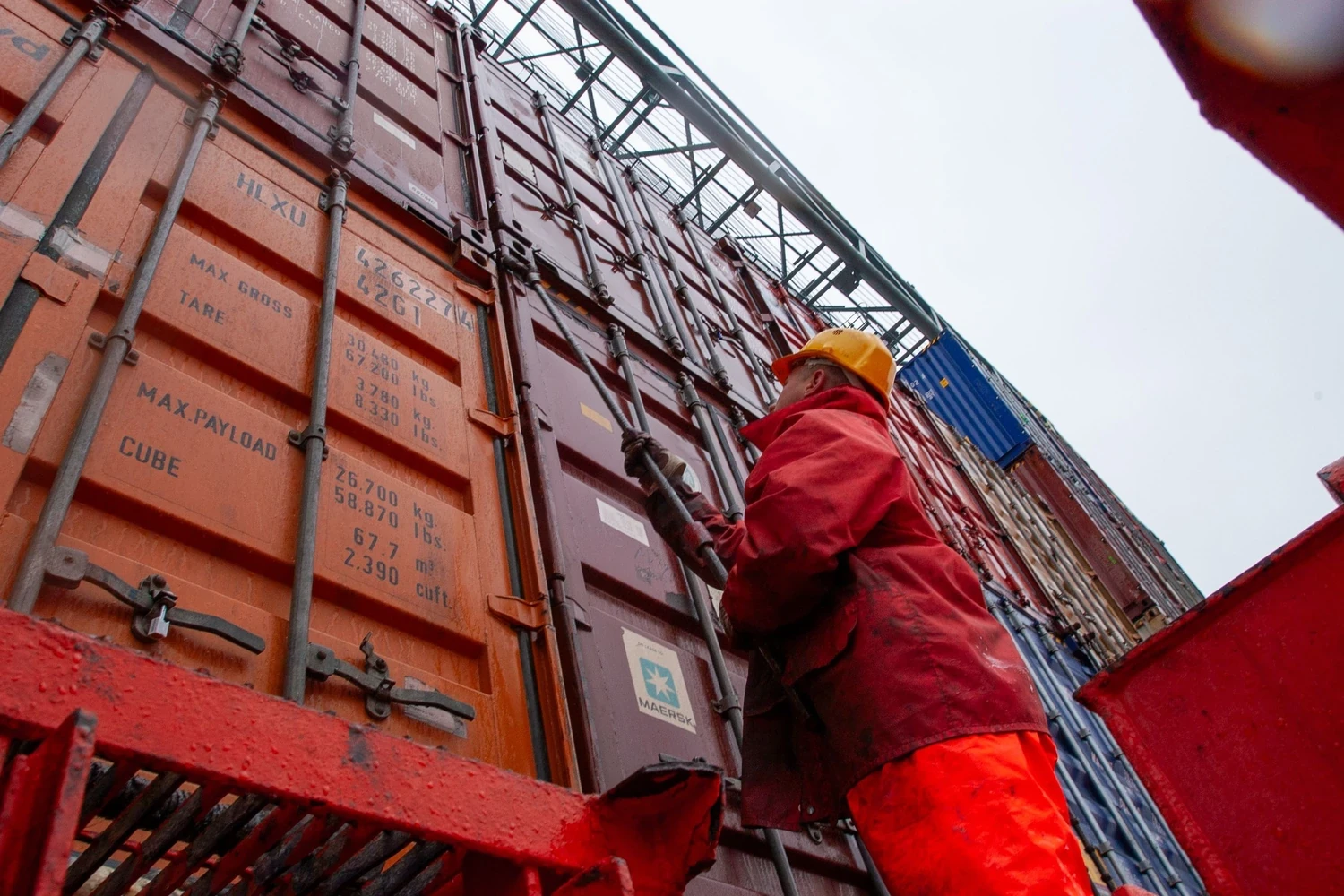
A container cleared through customs in Hamburg on Tuesday morning does not remain in Hamburg. A few hours later, it is usually on a curtain-sided semi-trailer heading south and east – and for a significant portion of this cargo, "east" means Poland, the Czech Republic, Austria, or Hungary.
This leg of the journey receives significantly less attention than the ocean transport that preceded it. On paper, it seems simple: no customs border, no vessel schedule, just a truck and a highway.
In practice, the pre-carriage and on-carriage have their own rules, their own bottlenecks, and their own pricing logic. Anyone who plans this incorrectly loses just as much money as with a missed departure at the seaport. Here is what actually happens as soon as the cargo leaves the terminal gate and rolls towards Central Europe.
Why the Hamburg–Wrocław corridor matters for distribution in Central and Eastern Europe
Hamburg's road connection to Poland is not an appendage of the seaport, but rather one of the reasons why so much cargo goes through Hamburg in the first place.
Wrocław (Breslau) is located around 680 kilometers southeast of the port. That is close enough for a single truck to usually manage the distance, and close enough to the Czech border for the city to also serve as a transshipment point for Prague and everything south of it. Wrocław has developed into one of Poland's most important industrial and logistics locations, with suppliers from automotive, electronics, and mechanical engineering who need parts on schedule – and not when a feeder ship happens to call at a Polish port.
In terms of transport performance, Poland is the largest road freight transport country in the EU, ahead of Germany and Spain (Eurostat, data for 2025). Eurostat attributes the performance to the country of registration of the vehicles, not the country in which they are driven – Poland's top position therefore primarily reflects the size of its internationally oriented road freight transport. It is precisely this traffic that shapes the East-West axes between the German seaports and the Central European industry. Combined with the rail connection and the road corridor via Berlin, Hamburg thus functions as a logistics gateway for a significant part of Central Europe, not just for Germany.
How truck transport from Hamburg to Poland and beyond works
After the terminal, the shipment runs under a CMR consignment note – the international consignment note for road freight transport – and no longer under the customs documents that got it through clearance. If you regularly encounter abbreviations in daily transport whose meaning is not obvious, our glossary of the most important EU customs terms will help.
This is the crucial point for this leg: Germany, Poland, the Czech Republic, Austria, and Hungary all belong to the EU internal market. No customs declaration is necessary at any of these borders. Once customs and import VAT have been completed during customs clearance in Germany, the container rolls from Hamburg to Wrocław, Warsaw, or Vienna basically just like between two German cities.
Are there border controls between Germany and Poland?
Yes. Since July 2025, "no customs" no longer means "no border."
On July 7, 2025, Poland reintroduced temporary controls at its borders with Germany and Lithuania. Affected crossings include the A12 highway crossing Frankfurt (Oder) – on the Polish side, the Świecko freight crossing –, the A4 Ludwigsdorf near Görlitz, the A11 Pomellen, and the A15 Forst. Initially, the measure was scheduled to expire on October 2, 2026; the Polish Ministry of the Interior has extended it until March 30, 2027. Germany, for its part, conducts controls at the border with Poland.
These are not customs controls, but random document and identity checks. Nevertheless, they take time: in our experience, depending on traffic volume, fifteen minutes to over an hour are added. With a tight delivery window, this buffer belongs in the planning.
Status: September 2026. The regulation is temporary and has already been extended several times.
Driving and rest times: why some routes take two days
The second bottleneck has nothing to do with borders.
EU social regulations limit daily driving time to nine hours, extendable to ten twice a week. After a maximum of four and a half hours of driving time, a 45-minute break is due, and the shift is followed by eleven hours of rest time.
For a short run to Wrocław, this rarely plays a role. For Vienna or Budapest, it means that the journey legally cannot be made in one go. Therefore, a two-day transit time is planned there, instead of making a promise that the tachograph won't support.
Full truckload or less-than-truckload?
The cargo travels either as a full truckload (FTL) directly from Hamburg to a single recipient, or as less-than-truckload (LTL) in groupage transport – i.e., together with other shipments on one trailer and routed through a transshipment point.
LTL costs less per pallet but takes longer: the trailer waits until it is full, and the goods are handled again at the hub before going to final delivery.
The most important destinations: Wrocław, Warsaw, Prague, Vienna, and Budapest
The route to the south and east is not improvised. It essentially follows the axis that the EU lists as the West Balkans–Eastern Mediterranean European transport corridor – known as the Orient/East-Med corridor until the TEN-T reform of 2024. It connects the German seaports via Berlin, Dresden, and Prague with Vienna and Budapest and extends further into Southeast Europe. This also explains why infrastructure investments repeatedly land precisely along this axis.
Wrocław is the closest of the five destinations and is considered by many freight forwarders as a natural transshipment point for the rest of the region – if only because of its proximity to the Czech border. Warsaw is Poland's capital and largest single market; most full truckload and LTL shipments from Hamburg run directly there. In terms of road distance, Prague is the closest capital in Central and Eastern Europe to Hamburg and the gateway to the Czech market. Vienna and Budapest lie further out and function as gateways to Austria and Hungary, as well as further towards the Balkans and Romania.
How long does a truck transport from Hamburg to Central and Eastern Europe take?
As a guideline for full truckloads, Prague and Wrocław usually reach the destination within an extended working day, occasionally with an overnight stay depending on loading times. Warsaw takes one to two days, Vienna and Budapest regularly two due to driving and rest times.
Destination | Distance from Hamburg | Full Truckload (FTL) | Less-than-Truckload (LTL) |
Prague | approx. 640 km | 1 day | 2–3 days |
Wrocław (Breslau) | approx. 680 km | 1 day | 2–3 days |
Warsaw | approx. 850 km | 1–2 days | 3–4 days |
Vienna | approx. 970 km | 2 days | 3–4 days |
Budapest | approx. 1,150 km | 2 days, occasionally 3 | 4–5 days |
LTL transit times are consistently one to two days longer than a full truckload because the shipment waits for consolidation at the place of dispatch and is transshipped again at the hub along the way.
None of these values take into account extraordinary delays such as the border controls described above. A tight delivery window deserves a buffer – not a booking based on the best-case scenario.
How much does a truck transport from Hamburg to Eastern Europe cost?
Full truckloads on West and Central European routes are typically between 1.30 and 2.25 euros per kilometer for standard cargo. Short runs tend to be at the upper end because fixed costs such as loading and documents are distributed over fewer kilometers. For an FTL run Hamburg–Wrocław, this results in a mid three-digit to low four-digit amount, depending on the vehicle and season. Vienna and Budapest are correspondingly higher due to the additional kilometers and the overnight stay.
LTL is not billed per truck, but per loading meter (LDM). On cross-border routes, 195 to 245 euros per loading meter is common. This makes LTL the cheaper option until a shipment reaches about six to seven loading meters – i.e., about half a trailer.
Tolls and surcharges are added to the base rate, and these differ noticeably from country to country.
Cost component | Basis of calculation | Guideline |
Base rate Full Truckload | per kilometer | 1.30–2.25 € |
Base rate LTL | per loading meter | 195–245 € |
Truck toll Germany | per tollable kilometer | scaled by number of axles, emission and CO₂ class; older vehicles pay significantly more |
e-TOLL Poland | per tollable kilometer, scaled by emission class | rates increased at the beginning of 2026, toll network expanded |
Toll Austria, Czech Republic, Hungary | route-based, by number of axles and emission class | annual tariff adjustment |
Diesel surcharge | percentage of the base rate | 15–35 % |
The difference between a quoted figure and the final invoice can be significant if these items are not listed separately. As with ocean freight to Hamburg, quotes can only be meaningfully compared if the base rate, toll, surcharges, and document fee are each on a separate line – instead of disappearing into a single number.
Ocean freight to Hamburg and truck on-carriage from a single source
On-carriage is the land transport leg that follows the ocean freight – and it does not happen in isolation from the ocean transport before it.
A shipment arriving at Burchardkai or Altenwerder and cleared through customs on the same day can be on a truck to Wrocław before the ship that brought it has left the port for its next port of call. Exactly this continuity is the real argument for routing cargo destined for Central and Eastern Europe via Hamburg instead of a Polish port, which first needs its own feeder connection.
We book and manage both legs as one shipment, not as two separate bookings: ocean freight to Hamburg, customs clearance upon arrival, and the subsequent truck run to Wrocław, Warsaw, Prague, Vienna, or Budapest – with one contact partner from booking to delivery. We have personnel at both ends of this corridor: a location in Hamburg and one in Wrocław, which makes coordination on the Polish side much shorter.
If a shipment is time-critical, the days are won here. Not on the ocean route.
Are you planning a specific route from Hamburg or do you want to have an existing supply chain checked? Contact us – we will calculate the leg with itemized positions so you can see what the price consists of.