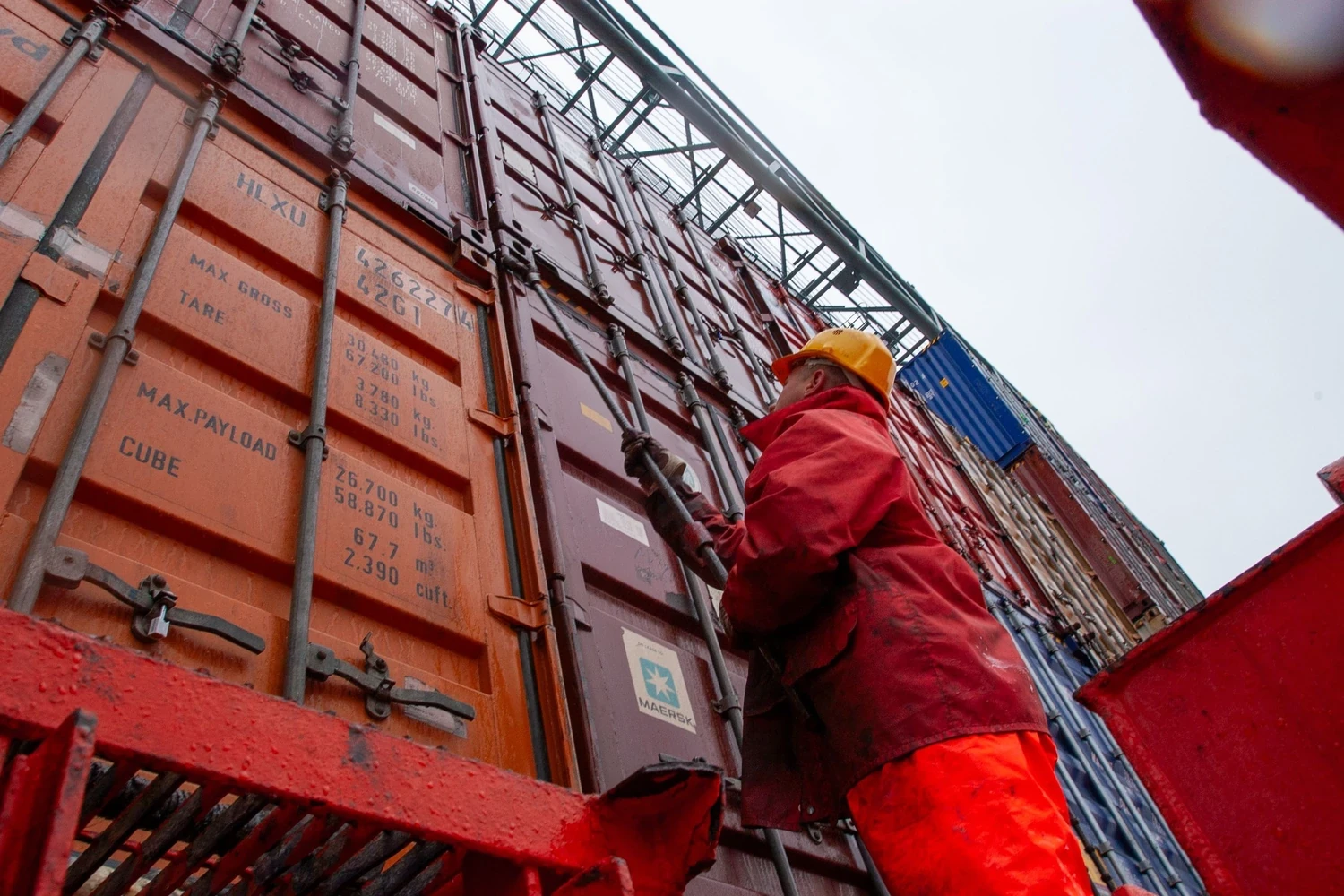
Two weeks ago, we used an incorrect invoice item as an example of how customs clearance works: a single discrepancy in the paperwork, and a container sits in Hamburg for a week. Last week's glossary provided you with the appropriate vocabulary. This post is the piece in between – what actually happens step by step once a shipment is booked, and at which point in this sequence a small discrepancy turns into a hold.
Five stages make up the process. Each has its own timing and its own way of failing.
Step 1 – Pre-declaration and Entry Summary Declaration
Clearance begins before a shipment physically arrives – with the entry summary declaration, or ENS: a security and risk-related declaration, not a request for release of the goods. It tells customs what is coming, who is sending it, and who is receiving it, so that a risk analysis can run before the ship or aircraft even reaches EU territory.
The declaration runs via ICS2, and the deadline depends entirely on how the goods are transported. Containerized sea freight requires an ENS submitted 24 hours before loading at the final non-EU port. For bulk cargo at sea, four hours before arrival applies, for road freight only one hour. For air freight, a minimum dataset before loading applies, which is submitted before the goods go on board; the complete dataset follows before departure or up to four hours before landing in the EU, depending on the flight duration. Generally, the carrier or freight forwarder declares, not the importer themselves – but the data comes from the importer's shipment details, so a discrepancy at this point remains their problem anyway.
A late or inconsistent ENS is one of the more avoidable causes of a hold because it flags a shipment before customs has even seen anything else about it. Everything downstream assumes it was clean.
Step 2 – Submitting the Customs Declaration
As soon as the goods arrive – or, in the case of centralized clearance, as soon as the declaration is submitted to the chosen customs office, regardless of the physical place of entry – the actual customs declaration is submitted. In Germany, this is done via ATLAS; other member states operate national systems based on the same EU data model.
This is a different declaration than the ENS, and it contains more details: the CN/TARIC code, the requested customs procedure (release for free circulation, a special procedure such as inward processing, or a transit procedure), the declared customs value, the country of origin, and the importer's EORI number. The declaration is made by the importer, by a customs representative on the basis of a power of attorney, or occasionally by the carrier.
Once accepted, the system issues an MRN – the reference used to track the shipment and, in the case of exports, to prove later that the goods have left EU territory. This step is also where most avoidable errors appear: a value that does not match the commercial invoice, an EORI number or company name that does not match the ENS, a goods description vague enough to plausibly fall under more than one HS code.
Step 3 – Assessment of Customs Duty and Import VAT
Once the declaration is accepted, the system calculates the duties. Customs duty is levied on the customs value, usually CIF: price of goods plus freight and insurance to the EU border, at the rate of the respective CN/TARIC code. Import VAT is then calculated on the customs value plus this duty, at the standard or reduced rate of the country of destination.
One number has already changed this year, and it is worth being precise about who this affects. The old customs exemption for shipments up to €150 expired on July 1, 2026; low-value B2C e-commerce parcels – i.e., goods sold directly to consumers from outside the EU – now carry a flat customs duty of €3 per product category (per tariff line), instead of entering duty-free. This is a transitional arrangement running until the EU Customs Data Hub is fully operational, expected around 2028; from then on, regular, classification-based customs clearance will apply to everything, regardless of value. A separate handling fee per parcel of around €2 is expected around November 2026. None of this affects ordinary B2B trade shipments, which were never covered by the old exemption anyway – but if you ship directly to end customers or advise clients who do, the calculation for low-value orders has permanently changed.
Payment itself can be made on a shipment-by-shipment basis or, for regular importers, via a deferment account that bundles the duties into a monthly statement. Either way, customs duties and import VAT must be settled or a deferment account confirmed before the goods are released – which is why this and the next step usually run in parallel rather than strictly sequentially.
Step 4 – Document and Goods Control
In parallel with the assessment of duties, ATLAS or the corresponding national system assigns each declaration to one of three channels. Green releases the goods without further examination. Yellow holds the shipment for a document check: a customs officer compares the declaration with the invoice, packing list, and the submitted certificates. Red adds a physical inspection of the goods themselves.
Most declarations with clean, consistent paperwork end up on green or yellow. Red is reserved for shipments with a higher risk profile, certain product categories, or random selection – and it is the step that takes the longest because it depends on the availability of inspectors and access to the cargo, not just the processing time of the paperwork.
Certificates are also checked here: phytosanitary certificates, CE declarations of conformity, safety data sheets, import licenses – depending on what is being moved. A missing document does not just cost time. For a product that is actually subject to control, it can mean that the shipment is completely denied entry.
Step 5 – Release of Goods
Once the inspection is complete and customs duties and import VAT have been settled or covered by a deferment account, the goods are released for free circulation. This is the point at which they are no longer subject to customs supervision and become ordinary Union goods – free to go to a warehouse, a distributor, or an FBA warehouse without further customs involvement.
For imports, this is a straightforward handoff from the terminal or customs warehouse. For exports, it works the other way around: as soon as the goods have physically left EU territory, an export release note is recorded for the export declaration. This confirmation is important far beyond logistics. It is the basis for treating the associated sale as a tax-exempt export delivery – and without it, an exporter has nothing in hand if this tax exemption is ever questioned.
How Long the Entire Process Takes
The timing varies so much depending on the channel and mode of transport that a single average value is of little use. A few reference points help more than an estimate.
An EORI number must exist before a shipment even reaches ATLAS, and the processing time for registration is inconsistent enough that a lead time of four to six weeks is the safe assumption, not the worst-case scenario. The ENS itself is submitted between one hour and a full day before arrival, depending on the mode of transport, as described above.
From declaration to release: An express air freight shipment with clean paperwork and a green result can be cleared in hours. Standard sea freight typically takes one to three business days, even if nothing goes wrong, and an inspection in the red channel adds another three to seven business days on top – depending on the port and how busy the inspectors are in that particular week.
Almost none of this variability comes from the declaration steps themselves. It depends on whether a shipment is routed to yellow or red – and that is decided based on what customs sees in the first three steps, not based on anything that happens afterward.
How to Avoid the Most Common Delays
The same handful of causes account for most holds, and every single one of them can be avoided before a shipment is even booked:
Apply for the EORI number well ahead of the shipment, not when it is already on its way.
Align product descriptions exactly across invoice, packing list, and declaration. "Parts" or "accessories" reads as a risk flag; a precise description does not.
Keep the declared value identical across ENS, invoice, and customs declaration – a discrepancy is one of the most common triggers for a manual check.
Have regulatory certificates ready before the goods arrive, and not only when a hold in the yellow channel asks for them.
Use ISPM-15 compliant wood packaging material. Untreated pallets remain a completely avoidable cause of delay.
If you ship regularly, look into a deferment account and, in perspective, AEO status; both reduce friction permanently rather than on a shipment-by-shipment basis.
Most of this boils down to the same thing: making sure the numbers and descriptions on every document tell the same story before anyone at customs has to ask why they don't. Contact us, and we will go through your process from start to finish to find where this is most likely to happen.


